

Continuous innovation is the heart and engine of Bodi.Me.
Fashion fit technology cannot stand still because bodies, garments, workforce demographics, regulations and business systems are constantly evolving. Continuous research and development keeps sizing technology relevant, accurate, scalable and commercially valuable.
When a business partners with Bodi.Me, it does not simply adopt Size-Me as a sizing solution. It gains a long-term technology and operational partner—and access to a specialist digital team with deep knowledge of body data, garment construction, fit, size demand and apparel supply chains.
More than a sizing solution
Successful innovation is not about adding technology for its own sake. It is about identifying the right technical solution for a real operational problem.
Bodi.Me listens closely to its customers’ challenges, including:
- Excess stock in some sizes and shortages in others
- High volumes of size-related returns and exchanges
- Expensive emergency uniform re-orders
- Limited visibility of future size demand
- Complex international uniform programmes
- Technology that is difficult to integrate or use
We translate these challenges into cost-effective technical tools that can be implemented within existing e-commerce, ordering and uniform-management workflows.
Our Size-Me fashion fit technology works with only a few simple, non-intrusive wearer inputs. It does not require photographs or body scans during standard use.
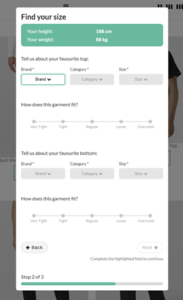
Behind that simple experience lies more than a decade of extensive research. Bodi.Me continuously analyses, validates and enriches its proprietary body-data resources, with a growing knowledge base now representing nearly one million body profiles.
These expanding datasets are used to continually retrain, test and refine our machine-learning models. In parallel, we constantly improve and personalise the wearer journey while advancing our proprietary algorithms to address the specific fit requirements of different garments—including particularly complex, gender-neutral or non-standard garment collections.
The objective is clear: make advanced technology simple for the wearer, easy for the customer to implement and capable of generating measurable value through better production planning, stock allocation and size distribution.
Why is continuous R&D essential in fashion fit technology?
The short answer is that fit is a moving target. Three developments make continuous research particularly important.
-
Adapting to real-world body changes
Human bodies are not static. They change through age, lifestyle, occupation, health, geography and wider demographic trends.
The expanding use of GLP-1 weight-management medicines—sometimes loosely described as the “Ozempic effect”—introduces another factor that may accelerate changes in population size profiles. In April 2026, NHS England reported that up to 1.2 million additional people could become eligible for semaglutide, marketed as Wegovy for weight management. Ozempic is another semaglutide brand, primarily prescribed for type 2 diabetes. NHS England
These macro-health trends matter to uniform providers, garment manufacturers and employers. Historical size curves cannot automatically be assumed to represent tomorrow’s workforce.
Bodi.Me continuously tests and refines its predictive models against evolving body data and real-world fit evidence. This helps businesses respond to changing wearer populations, plan more appropriate size distributions and reduce avoidable stock imbalances, exchanges and emergency re-orders.
-
Reducing regulatory and environmental risk
Poor size planning creates waste at both ends of the supply chain: unwanted inventory before distribution and unnecessary returns, exchanges and transportation afterwards.
The regulatory environment is also becoming more demanding. From 19 July 2026, large companies operating across the European Union are prohibited from destroying unsold clothing, accessories and footwear, except in limited circumstances. Medium-sized companies will become subject to the rules in 2030.
The European Commission estimates that between 4% and 9% of textile products placed on the European market are destroyed before being used—equivalent to approximately 264,000 to 594,000 tonnes each year. European Commission
Accurate size-demand intelligence can help organisations:
- Produce and purchase quantities closer to actual demand
- Allocate the right sizes to the right locations
- Reduce excess inventory and size shortages
- Limit unnecessary returns, exchanges and transportation
- Support ESG, waste-reduction and circularity objectives
- Make more informed production and procurement decisions
Technology does not replace a company’s regulatory responsibilities, but it can provide better data for preventing waste before it is created.
-
Enabling seamless global scalability
As uniform programmes reach international workforces, the sizing and fit technology deployed must understand how to engage clearly and effectively with wearers in each region.
This means asking simple, relevant and easily understood questions. It also means accommodating different languages, familiar local size references, regional body profiles, garment specifications, measurement units, data formats and ordering systems.
True localisation requires more than translating the same interface word for word. The complete wearer journey must feel intuitive and relevant to the person using it, wherever they are located.
Bodi.Me’s R&D therefore extends well beyond predictive algorithms. It includes:
- Truly localised and personalised regional wearer journeys
- Local languages, terminology and garment descriptions
- Familiar regional size references and chart mappings
- Different measurement systems and data formats
- Integration with ordering, ERP and uniform-management platforms
- Secure deployment and data-governance processes
- Quality assurance across different devices and markets
- Tools for managing complex international garment programmes
This ongoing development reduces the friction and cost of global rollouts. It also protects the customer’s technology investment by allowing Size-Me to evolve alongside its business, workforce and international requirements.
How Bodi.Me turns R&D into customer value
more ambitious technologies and new applications.
| R&D activity | What it includes | Value for customers |
| Internal R&D | Machine-learning models, proprietary algorithms, body-data analysis, multilingual UX and integrations | More accurate, practical and scalable tools |
| Customer-led R&D | Discovery, garment calibration, wearer testing, pilots and analysis of operational problems | Solutions aligned with real workflows and commercial KPIs |
Connecting academic research with industry
External collaboration is essential because some of the most valuable innovation happens where different disciplines meet.
Bodi.Me has collaborated with leading institutions, including London College of Fashion, University of the Arts London, and, more recently, The University of Manchester.
These relationships bring together expertise in body measurement, garment engineering, pattern development, digital fit, manufacturing and sustainability. They allow technical ideas to be evaluated beyond the software environment and followed through into physical patterns and garments.
From a 3D body scan to two made-to-measure garments
On 9 July 2026, Bodi.Me participated in the M-ADE @ UoM Industry Engagement Event at The University of Manchester. The event explored 3D body scanning, engineered pattern development, bespoke garment production and on-demand local manufacturing.
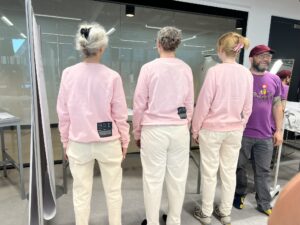
Bodi.Me actively contributed a 3D body scan, enabling researchers to use the resulting body data to support the development of engineered patterns and two made-to-measure garments.
The experiment followed a complete digital-to-physical process:
- Capture the body’s dimensions, proportions and posture through 3D scanning.
- Process the scan data into usable body measurements.
- Translate those measurements into engineered garment patterns.
- Produce two made-to-measure garments directly from the body data.
- Evaluate how digital body information translates into real garment fit.
The University of Manchester’s specialist facilities include a body scanners capable of generating measurement lists and 3D files for product development and analysis. University of Manchester Department of Materials
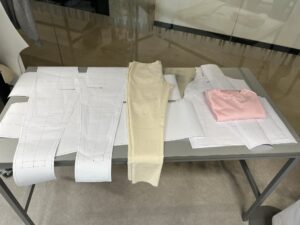
This practical research demonstrated how body data can connect pattern engineering with local, on-demand production—potentially reducing sampling, unnecessary inventory and dependence on standardised size assumptions.
Importantly, Size-Me’s standard wearer journey remains scan-free. 3D scanning is used selectively in controlled research, calibration, bespoke and made-to-measure applications where it adds genuine value and where appropriate consent and data-governance processes are in place.
What does continuous R&D mean for Bodi.Me customers?
It means that Size-Me is never treated as a finished, static product.
Customers benefit from technology designed to:
- Remain responsive to changing body profiles and wearer requirements
- Improve size-demand forecasting and stock optimisation
- Address the fit requirements of challenging garment collections
- Reduce avoidable returns, exchanges and re-orders
- Integrate efficiently with existing business systems
- Deliver localised and personalised international wearer journeys
- Support multilingual and multi-location deployments
- Evolve with regulatory, environmental and commercial priorities
Continuous R&D allows Bodi.Me to connect what the industry needs today with what will become possible tomorrow—from recommending the right size first time to helping businesses manufacture, stock and distribute the right quantities before a garment is ordered.
Innovation with a commercial purpose
For Bodi.Me, research and development is not an activity separate from the business. It is the mechanism through which customer problems become scalable, cost-effective solutions.
Partnering with Bodi.Me therefore means investing in more than sizing software. It means working with a long-term digital innovation partner committed to improving fit, reducing operational waste and building a more responsive, profitable and sustainable garment supply chain.
Book a Bodi.Me demonstration to explore how Size-Me can support your production, stock-distribution or global uniform-sizing strategy.
Frequently asked questions
Why is continuous R&D important for garment sizing?
Body profiles, garment specifications, workforce demographics and size demand change over time. Continuous R&D helps sizing models remain relevant, accurate and commercially useful.
Does Size-Me require a photograph or 3D body scan?
No. Size-Me normally uses a small number of simple, non-intrusive inputs and does not require photographs or body scans. Scanning is used selectively for specialised research, calibration and made-to-measure applications.
How can Size-Me support stock optimisation?
Size-Me connects wearer requirements with garment-specific sizing. Aggregated demand intelligence can help businesses plan quantities, allocate sizes and identify potential shortages or excess stock before production and distribution.
Can Size-Me support international uniform programmes?
Yes. Bodi.Me’s ongoing R&D includes localised wearer journeys, regional size references, multilingual interfaces, flexible integrations and repeatable deployment processes for international and multi-location programmes.
How does external R&D benefit customers?
Academic and industry collaboration gives Bodi.Me access to specialist knowledge, research facilities and new methods for testing body data, garment patterns, fit and on-demand manufacturing.