
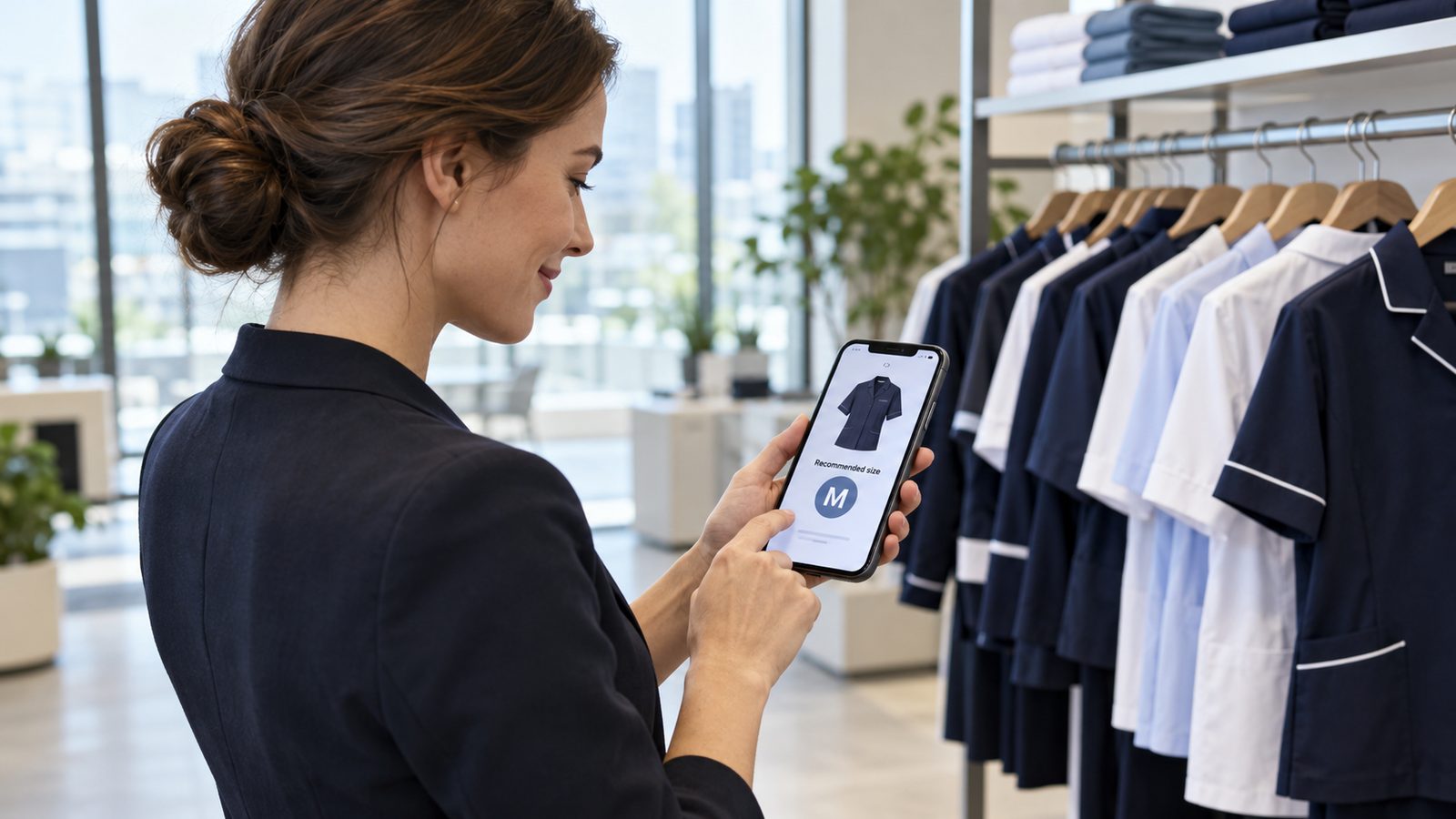
For uniform, workwear and professional clothing programmes, incorrect sizing is not only a fit problem. It affects returns, exchanges, staff time, stock levels, distribution, working capital and garment waste. Fashion fit technology – also known as apparel fit technology or digital sizing technology – can help organisations recommend the right garment size remotely while generating better data for production, purchasing and stock planning.
The strongest fit technologies do more than replace a fitting room. They connect wearer information with garment-specific data so that each person receives a personalised recommendation and the organisation gains a clearer view of real size demand.
What is fashion fit technology?
Fashion fit technology is software or hardware that helps match an individual to the most appropriate clothing size and fit without relying solely on a traditional in-person fitting. Depending on the system, it may use 3D body scanning, smartphone imaging, manual measurements, large body-data sets or a small number of wearer questions combined with garment data and predictive algorithms.
For uniforms and workwear, the key requirement is garment-specific accuracy. A wearer may need one size in a shirt, another in trousers and a different fit in outerwear or PPE. Digital sizing therefore needs to understand both the wearer and the actual garment range – not simply map a person to a generic size label.
Direct answer: Apparel fit technology helps optimise clothing fit by using wearer data, garment measurements and algorithms or AI to recommend the most suitable size before an order is placed.
1. You can keep your existing size range and grading
One of the most common objections to digital sizing is: “Our current size range already works.” That may be true. The challenge is often not the size range itself, but allocating each wearer to the right size within it.
A good apparel fit technology should work with the garment data you already have – from size charts and finished garment measurements to technical specifications and grading information. It does not require a supplier to redesign an established collection simply to introduce digital sizing.
For uniform providers using third-party garments, the same principle applies. Each style can be calibrated against its own size and fit information so recommendations reflect the specific garment rather than a generic XS-to-XXL assumption.
This means digital sizing can be introduced as an additional decision layer: the garment range stays the same, but the process of matching wearers to it becomes more consistent and data-led.
2. Even modest return rates create avoidable cost
Uniform businesses may experience lower return rates than many online fashion retailers, but a wrong-size garment can still create disproportionate operational cost. A single sizing error can trigger customer-service activity, return handling, replacement picking, additional shipping, stock adjustments and, in some cases, alterations or write-offs.
Branded or role-specific garments create an additional challenge because they may be difficult to reallocate to another wearer. The commercial cost is therefore wider than the value of the garment itself.
Digital uniform sizing moves the decision upstream. Instead of correcting the wrong size after delivery, the objective is to improve the first recommendation before the order is submitted.
Bodi.Me reports that Size-Me has delivered more than 1.5 million personalised size and fit recommendations, with up to 98.7% recommendation accuracy in qualifying deployments. Across client projects, Bodi.Me also reports reductions of more than 80% in garment returns. Results vary by collection, garment calibration, available wearer data and programme processes.
3. Physical fitting sessions consume time across the programme
Traditional uniform sizing can involve sample sets, trained fitters, appointments, changing rooms, measurement sessions and repeated administration. For a distributed workforce, this can be difficult to coordinate and can slow down rollout before procurement and distribution even begin.
Digital sizing allows employees to complete the process remotely and at a convenient time. Instead of bringing every person to a physical fitting session, the organisation can collect size requirements digitally before garments are issued.
With Size-Me 5.1, employees can access the sizing journey through an existing ordering system, a secure URL or a QR code. The platform is optimised for smartphones and does not require an app download. This makes the process particularly relevant to frontline, distributed and international workforces.
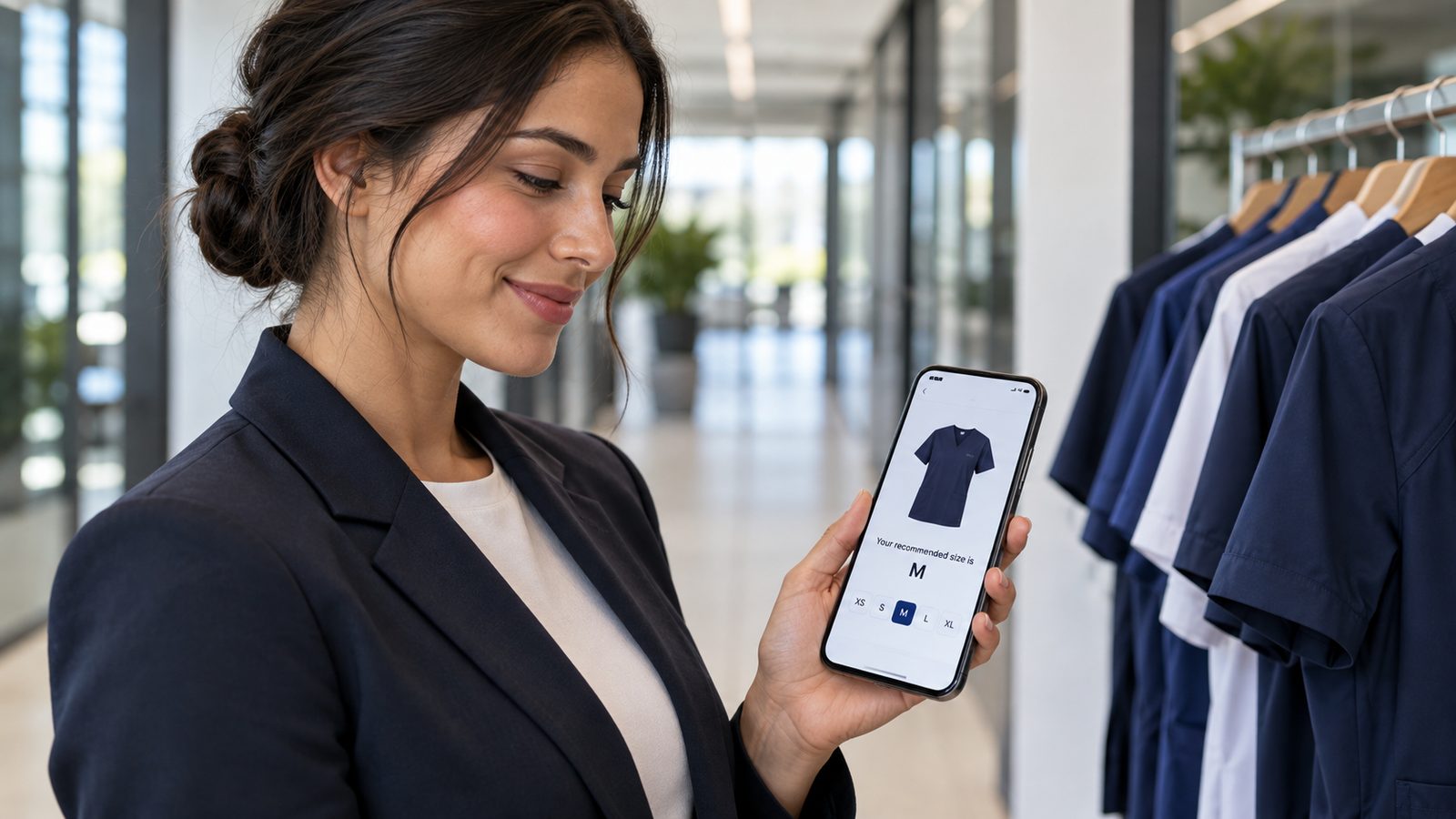
The benefit is not simply convenience for the wearer. Earlier and more complete size information can give procurement and operations teams better visibility of demand before stock is allocated or production quantities are finalised.
4. Digital sizing does not have to mean photos or body scans
Privacy is a legitimate concern in workplace sizing. Some digital fit systems rely on photographs, videos, body scans or tight-fitting clothing. Those approaches can be appropriate in certain applications, but they are not the only route to an accurate recommendation.
Size-Me 5.1 uses a small number of simple, non-intrusive wearer inputs combined with garment-specific information. Its standard process does not require photographs, body scans, specialist hardware or an app download.
This can make adoption easier for organisations that need to consider employee privacy, inclusion and accessibility, while still moving away from manual fitting processes.
The practical question for a uniform programme is therefore not “Do we want body scanning?” but “What level of wearer input and garment data is required to achieve the accuracy we need?” Different programmes can select the technology and calibration approach appropriate to their risk, garments and operating model.
5. Better fit data can optimise the entire uniform supply chain
The most important development in apparel fit technology is that the value no longer stops at the individual size recommendation.
When anonymised sizing demand is aggregated across a workforce, it can help organisations understand how many garments are likely to be required in each size – by garment, role, site, region or distribution point. This turns sizing from a customer-service function into supply-chain intelligence.
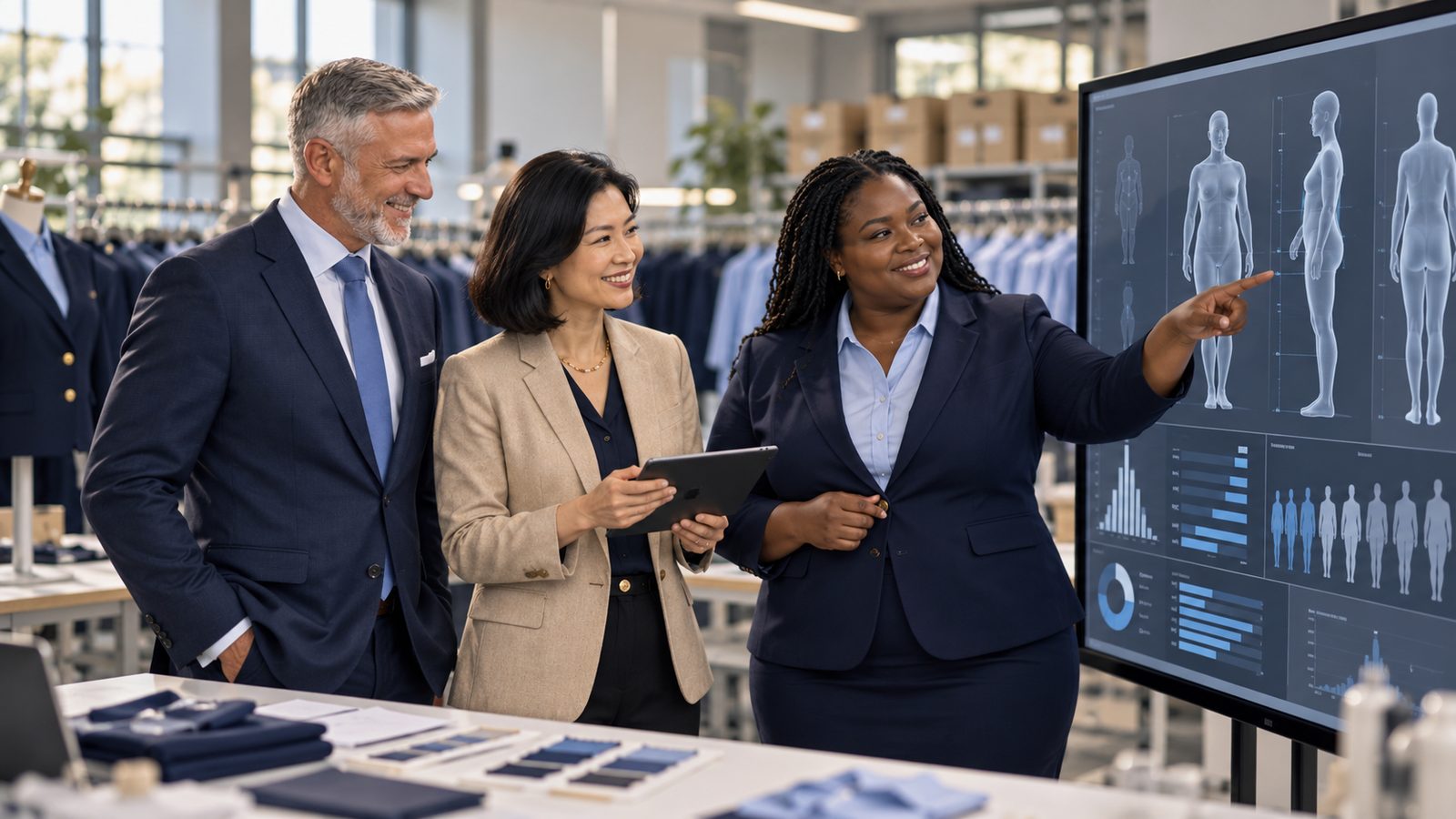
Better demand visibility can support organisations to:
- plan more accurate size curves before production or purchasing;
- reduce overstock in low-demand sizes and identify likely shortages earlier;
- allocate the right sizes to the locations where they are actually needed;
- reduce emergency replenishment, stock transfers and repeat deliveries;
- make better use of working capital tied up in garment inventory; and
- reduce avoidable overproduction and garment waste.
This matters even when garments use recycled or lower-impact materials. Sustainability is not only a question of fibre choice; it is also a question of producing the right quantities and keeping garments in productive use.
Why size-demand data matters more in 2026
Uniform programmes are increasingly digital, mobile and geographically distributed. At the same time, apparel businesses face greater pressure to control inventory and prevent unnecessary waste.
In the European Union, rules under the Ecodesign for Sustainable Products Regulation began applying to large companies on 19 July 2026, prohibiting the destruction of certain unsold apparel, clothing accessories and footwear except in defined circumstances. The European Commission has explicitly encouraged better stock management alongside reuse, remanufacturing, donation and other alternatives to destruction. Businesses should assess how the rules apply to their own products and operating model.
For uniform and workwear suppliers, the strategic implication is broader: excess stock is increasingly a financial, operational and sustainability issue. Better sizing information can help prevent some of that excess before garments are manufactured or purchased.
How Size-Me 5.1 turns fit into supply-chain intelligence
Bodi.Me’s Size-Me 5.1 is designed around two connected outcomes: helping each wearer select the right garment size first time, and helping organisations understand the quantities required across the size range.
A typical digital sizing journey can work as follows:
- The employee opens Size-Me through the organisation’s ordering platform, a secure URL or a QR code.
- They answer a small number of simple questions relevant to the configured sizing journey.
- Size-Me combines the wearer profile with calibrated garment data to generate a garment-specific size and fit recommendation.
- The employee selects the recommended size as part of the normal ordering process.
- Aggregated and anonymised demand data can then support purchasing, production, stock allocation and distribution planning.
According to Bodi.Me’s published 2026 project results, Size-Me has delivered more than 1.5 million recommendations, achieved up to 98.7% sizing accuracy, reduced garment returns by more than 80% and helped reduce apparel overproduction by more than 70% across qualifying client projects. Outcomes depend on the garments, calibration, implementation and operating process.
The business case for apparel fit technology
The question is no longer whether digital sizing can replace a tape measure. The stronger business case is whether it can improve decisions before cost and waste enter the supply chain.
For the wearer, that means a faster and more private route to the right size. For the supplier or employer, it means better information about what needs to be manufactured, purchased, stocked and distributed.
The result is a more responsive uniform programme built around real wearer demand rather than assumptions.
Right size. Right quantity. Right location. First time.
Frequently asked questions
What is apparel fit technology?
Apparel fit technology is a digital system that uses wearer information and garment data to recommend the most appropriate clothing size and fit. It can include AI sizing software, measurement tools, 3D body scanners, smartphone imaging or data-led recommendation systems.
What technology helps optimise clothing fit?
Digital sizing and apparel fit technologies help optimise clothing fit by matching a wearer profile to the measurements, grading and intended fit of a specific garment before the order is placed.
Can digital uniform sizing work without photos or body scans?
Yes. Some platforms require photographs or scans, while others do not. Size-Me 5.1 uses a small number of non-intrusive inputs and does not require photos, body scans, specialist hardware or an app download in its standard wearer journey.
Does digital sizing work with an existing uniform range?
Yes. A size recommendation platform can be calibrated to an existing garment range using the supplier’s available size and garment data. Introducing digital sizing does not automatically require a redesign of the collection.
How can apparel fit technology reduce uniform returns?
It reduces avoidable size-selection errors by recommending the most suitable garment size before the employee orders. Better first-time fit can reduce exchanges, replacement shipments, customer-service handling and related operational costs.
Can digital sizing improve uniform stock planning?
Yes. Aggregated size-demand information can show expected demand by garment, size, role, site or region. This can help organisations improve size curves, purchasing quantities, inventory allocation and replenishment planning.
How does digital sizing support sustainability?
Better sizing and demand forecasting can reduce avoidable exchanges, transport, excess inventory and overproduction. This complements material-level sustainability initiatives such as recycled fibres by addressing waste earlier in the supply chain.
Can Size-Me integrate with an existing uniform ordering system?
Yes. Size-Me can integrate with e-commerce, uniform-ordering and workforce-management systems, subject to the client’s technical requirements. It can also be accessed through a secure URL or QR code.
Ready to improve uniform fit and size-demand planning?
Discover how Size-Me 5.1 can help your organisation improve first-time fit and connect sizing data with production, stock and distribution decisions. Book a Bodi.Me demo.
Sell More. Waste Less.