
Insights from the ETSA and Assosistema conference in Milan | 24 October 2026
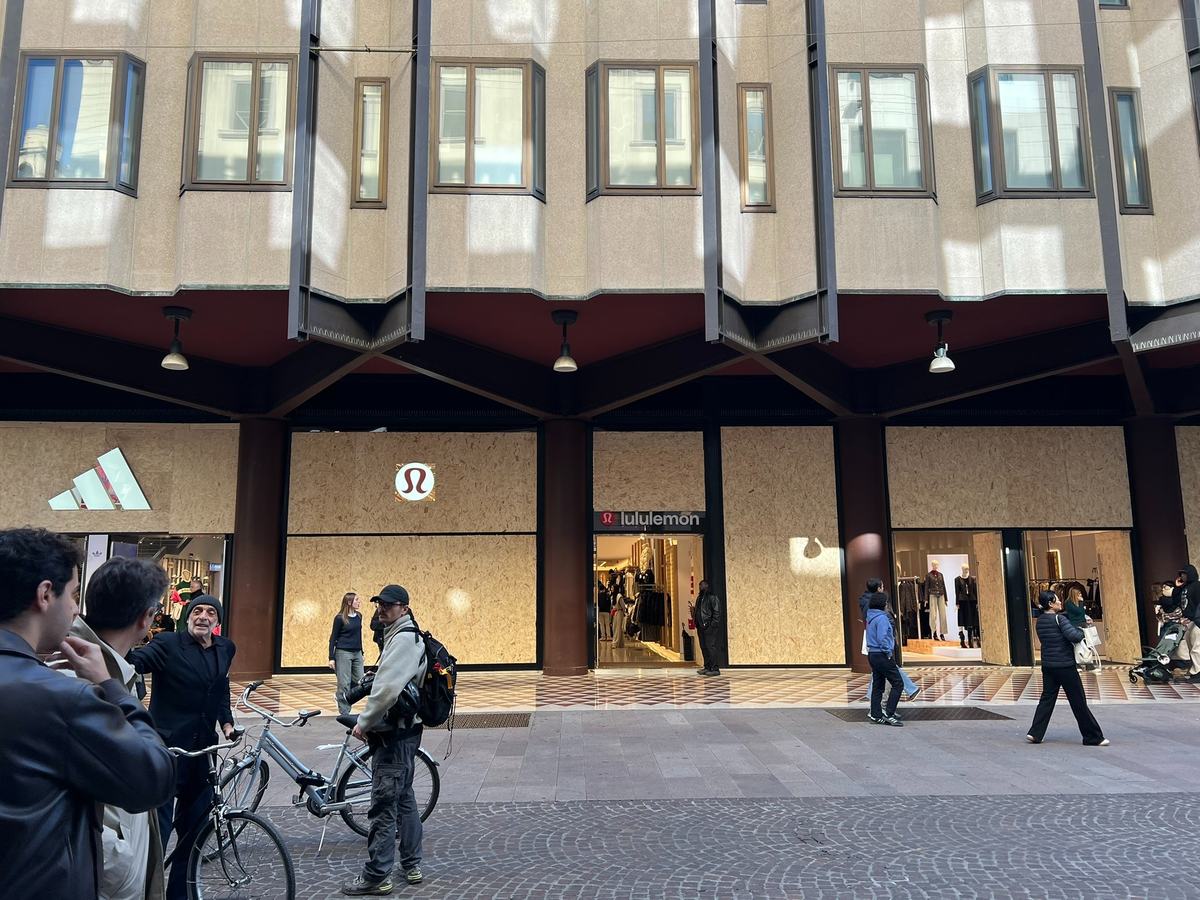
While boutiques in Milan’s city centre boarded up their windows and some shops closed amid fears of renewed looting, police and security personnel prepared to protect the public and maintain order. At Fiera Milano Rho, we were attending EXPODETERGO INTERNATIONAL 2026, where the future of textile care, uniforms and workwear was under discussion. [6, 7]
The scene brought the purpose of professional clothing into sharp focus. For police officers and other first responders, well-fitting uniforms support comfort and freedom of movement. Personal protective equipment (PPE) must also suit the wearer, the hazards and any other equipment worn alongside it. Behind every uniform programme are people who need to carry out demanding roles with clothing and equipment appropriate to their work. [8]
Against this backdrop, the ETSA and Assosistema conference explored how textile and uniforms services can become more sustainable while remaining commercially competitive. Three connected priorities emerged: improving energy and water efficiency, building effective textile recovery systems, and investing in innovation with a measurable return.
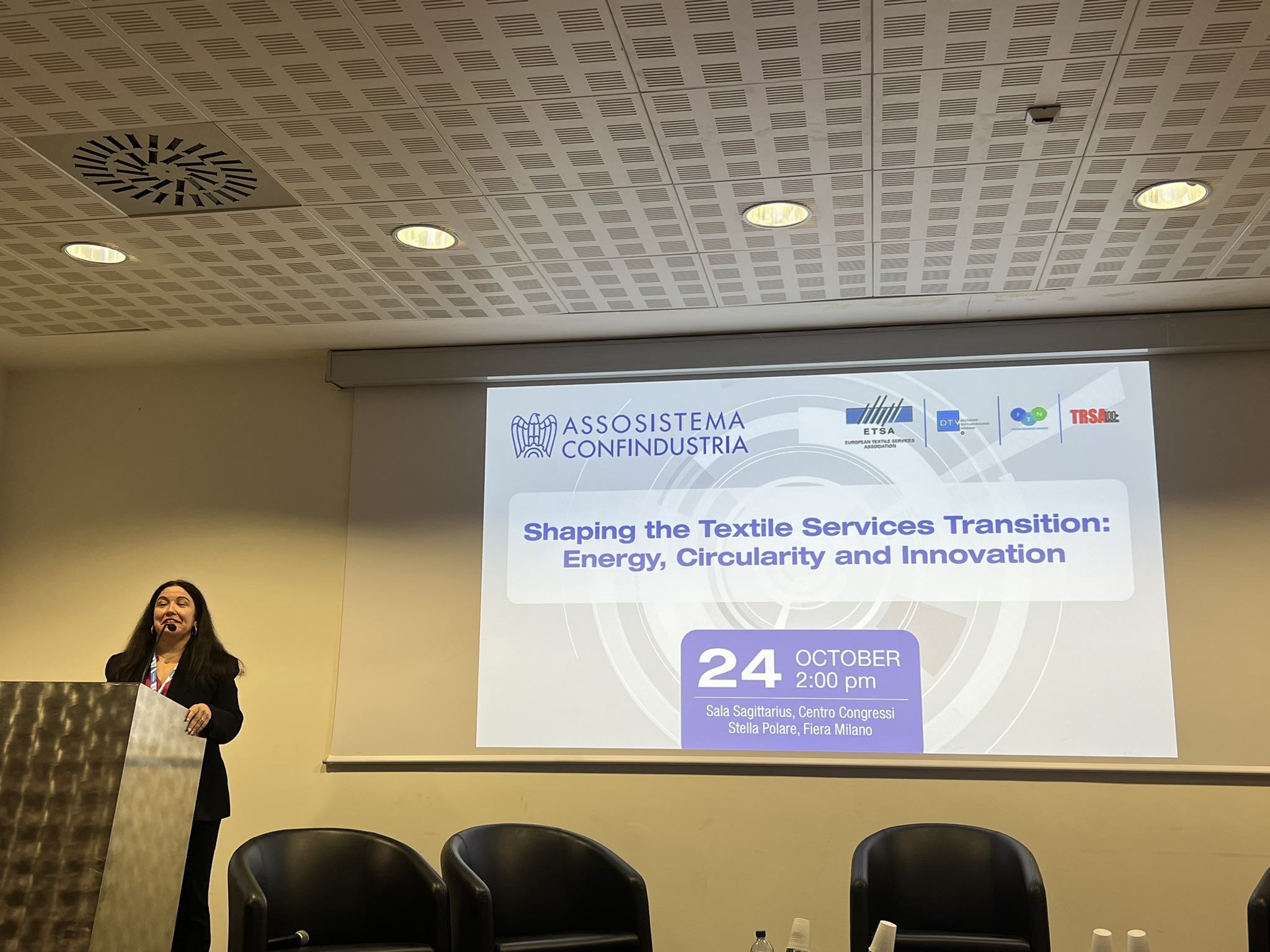
Held on 24 October during the 23–26 October exhibition at Fiera Milano Rho, the conference, “Shaping the Textile Services Transition: Energy, Circularity and Innovation”, brought together textile rental operators, industry associations and technology suppliers. [1, 2]
For Bodi.Me, the discussions reinforced an opportunity across uniform and workwear supply chains: combine more efficient garment care with better decisions about which garments to manufacture, purchase, stock and distribute.
Decarbonising industrial laundries: the business case matters
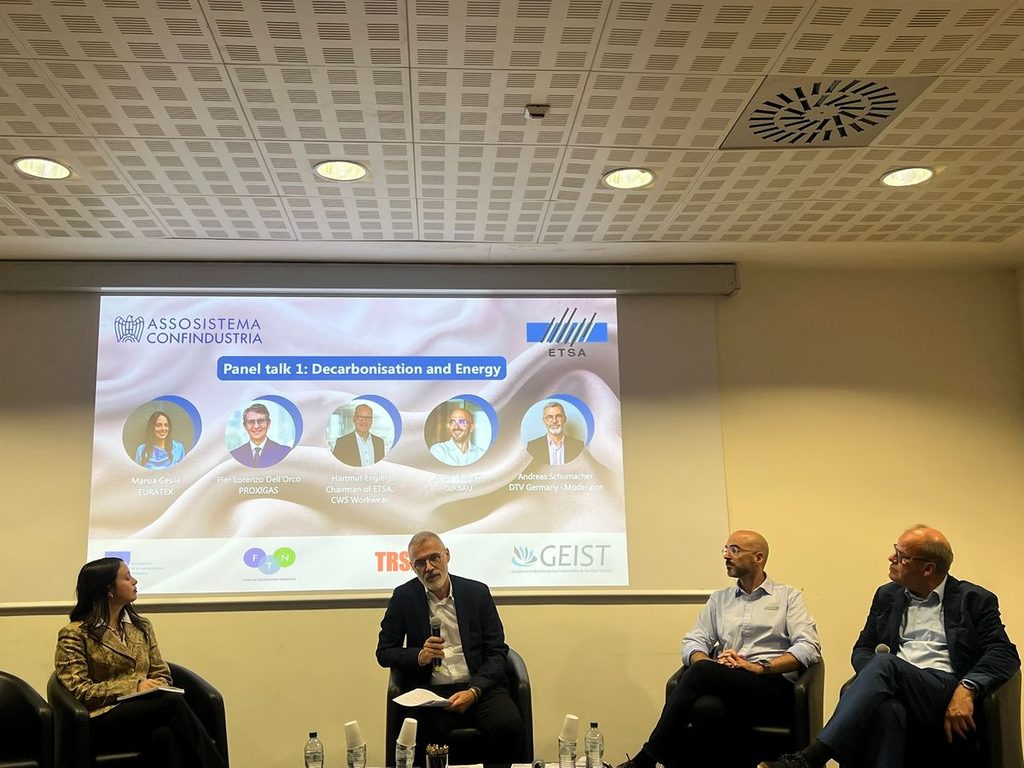
Moderated by Andreas Schumacher, Managing Director of DTV Germany, the energy panel brought together Hartmut Engler, ETSA Chairman and CWS Workwear CEO; Joan Vilaseca, GIRBAU’s Strategy Leader in Sustainability and Innovation; Marsia Cesile, Policy Officer at EURATEX; and Pier Lorenzo Dell’Orco, President of PROXIGAS.
Dell’Orco discussed Europe’s resilience in adapting its gas supply since Russia’s invasion of Ukraine in 2022, alongside the continuing challenge of securing reliable energy for industry.
Across the contributions from Engler, Cesile and Vilaseca, a recurring theme was the need for a clear investment case. Lower-carbon energy and technologies must be evaluated against operating costs, infrastructure requirements, reliability and payback.
For a laundry operator, this means assessing more than an equipment purchase price. Energy consumption, maintenance, productivity and garment processing requirements all affect the return on investment.
Waste heat and water efficiency: opportunities beyond the laundry
Vilaseca encouraged the industry to think more creatively about alternative energy sources, including recovering heat from data centres for nearby communities and industrial users. This points towards more connected local energy systems, where one organisation’s surplus heat becomes another’s resource.
Looking towards 2030 and beyond, the discussion explored integrated heat supply, greater automation and more efficient cleaning chemistry. These are opportunities to investigate against practical operating requirements; any changes to chemistry or processing must still meet the hygiene and performance standards of the textiles being treated.
Water efficiency was another priority. Reducing consumption requires attention to the complete process, including washing, rinsing, water recovery and the relationship between water, chemistry and energy. Collaboration between ETSA and national associations can help operators share experience and evaluate improvements.
Textile EPR: recognising how professional textile services operate
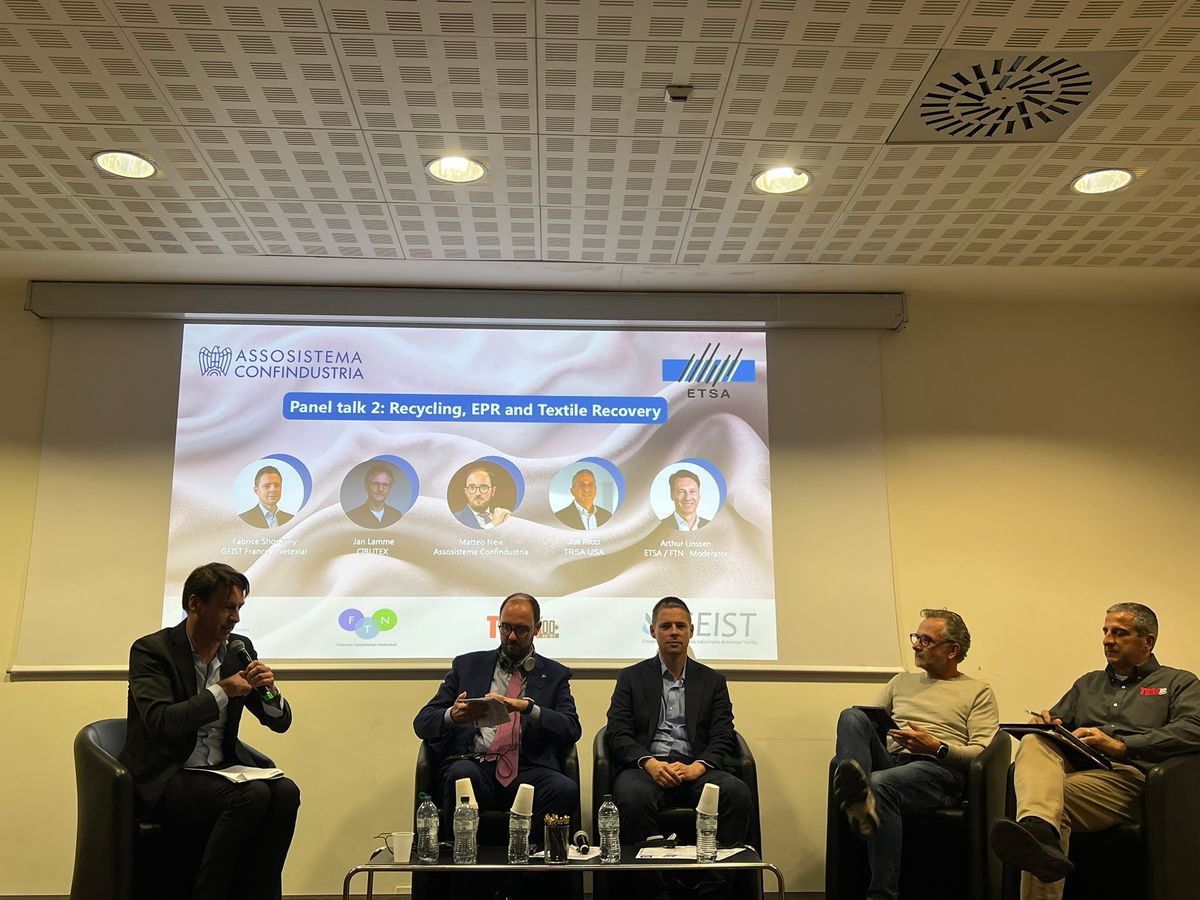
The recycling panel was moderated by Arthur Linssen, Chair of ETSA’s National Associations Council and Managing Director of FTN. Speakers included Fabrice Shoshany, President of GEIST France and CEO of Netexial; Jan Lamme, CIBUTEX Chairman and Lamme Textile Management CEO; Matteo Nevi, Director General of Assosistema Confindustria; and Joe Ricci, President and CEO of TRSA.
Extended Producer Responsibility, or EPR, makes producers responsible for financing specified end-of-life arrangements for their products. The revised EU Waste Framework Directive introduces common textile EPR rules, implemented through national schemes, with fees intended to support collection and waste management. [3]
A central concern in the panel was how those arrangements should recognise professional textile services. Rental garments and linen are managed assets, designed to support repeated use, laundering and, where appropriate, repair. Their operating model differs from rapid-turnover consumer fast-fashion.
Shoshany argued for an approach that reflects those differences. Nevi called for exclusions for uniforms, workwear and certain healthcare or contaminated-use clothing. These were industry policy positions; they should not be read as confirmation of blanket legal exemptions.
The distinction matters. Rules need to account for product scope, responsibility across rental and supply relationships, and the safe handling of contaminated textiles. Traceability should also support accountability for products entering the European market, including imports.
EPR and Digital Product Passports serve different purposes
EPR and Digital Product Passports, or DPPs, are related parts of Europe’s circular textile agenda, but they operate under different frameworks. EPR addresses responsibility for end-of-life management. Textile DPP requirements are being developed under the Ecodesign for Sustainable Products Regulation to make relevant product information accessible across the value chain. [3, 4]
For operators, the practical priority is consistent information: what a garment contains, how it can be maintained, and what recovery routes may be suitable. Textile-specific DPP requirements will be defined through a future delegated act; businesses should distinguish that developing framework from existing obligations. [4]
Recycling needs an operating model as well as a regulation
Lamme described how textile recycling activity began before EPR legislation, demonstrating that businesses can act ahead of regulatory requirements. Ricci highlighted the state-by-state nature of US regulation and the commercial opportunities in recovering and reusing fibres.
California already has a textile producer responsibility law, the Responsible Textile Recovery Act, with phased implementation. It provides a concrete example of textile stewardship developing at state level. [5]
The operational challenge extends beyond collecting used textiles. Businesses need suitable sorting, viable recovery partners and demand for recovered materials. End-of-life planning should therefore begin when textiles are specified and purchased.
The supply chain perspective: connecting suppliers and operators
Moderated by Ricci, the third panel brought together Ruggero Sammarco, Operations Director Laundry at CHRISTEYNS; Daniele Cantagalli, R&D Director at È COSÌ; Marco Gastaldi, CEO of INDUSTRIA TESSILE GASTALDI; Nicolas Gostony, Head of Marketing at JENSEN; and Alessandro Rolli, Managing Director of KANNEGIESSER ITALIA.
The session’s focus on suppliers and technology partners highlighted the breadth of the transition: textiles, chemistry, machinery and operating processes all have a role. From Bodi.Me’s perspective, connecting these decisions with wearer demand creates another opportunity to improve efficiency.
Bodi.Me’s perspective: prevent avoidable waste through better size planning
Energy efficiency and textile recovery address essential parts of a garment’s lifecycle. Uniform programmes can also reduce avoidable demand at the purchasing stage by improving size selection and planning quantities around the workforce.
Size-Me 5.1 uses Bodi.Me’s proprietary size-matching algorithms, AI and machine learning to recommend garment sizes from a few simple wearer inputs. The remote sizing journey requires no photographs or body scans.
For textile rental and industrial laundry businesses that own uniform stock, better sizing information can support:
- More informed procurement: use wearer size data to plan the quantity needed in each size.
- Better allocation: match stock to workforce requirements across roles and locations.
- Fewer size-related exchanges: reduce avoidable replacement orders and associated handling.
- Clearer stock visibility: identify size imbalances that can leave some garments unused while others are repeatedly reordered.
These benefits should be measured against a programme’s own baseline. Useful indicators include size-related exchange rates, unused stock by size, replacement shipments and stock value.
Our takeaway from Milan is that sustainable textile services need connected decisions across the whole supply chain, supported by a clear business case. Better fit and size planning can contribute alongside cleaner energy, efficient laundering, repair, reuse and recycling.
Right size. Right quantity. Right location. First time.
Discover how Bodi.Me’s Size-Me platform can support your uniform sizing and stock planning. Book a demonstration with our team at bodi.me.
Frequently asked questions
What were the main themes of the ETSA and Assosistema conference?
The conference covered decarbonisation and energy, recycling and textile EPR, and the contribution of supply chain partners to textile services innovation.
Are uniforms and workwear automatically exempt from textile EPR?
A blanket exemption should not be assumed. Applicable requirements depend on the jurisdiction, product scope and relevant scheme. Calls for exclusions at a conference are policy positions rather than confirmation of legal status.
How can digital sizing support industrial laundry and textile rental businesses?
Digital sizing helps match wearers to garment sizes. Aggregated sizing information can also support procurement and stock allocation, helping businesses address size-related exchanges and unused stock.
Sources
[1] EXPODETERGO INTERNATIONAL: exhibition dates and venue
[2] Assosistema: conference on 24 October 2026
[3] European Commission: revised Waste Framework Directive and textile EPR
[4] European Commission: textile apparel and the Digital Product Passport
[5] CalRecycle: Textile Stewardship programme
[6] Sky TG24: Milan boutiques protect shopfronts ahead of demonstrations, 24 October 2026
[7] Associated Press: security preparations and demonstrations in Milan, 24 October 2026
[8] HSE: selecting PPE for the wearer, including size, fit and compatibility