
Safety Expo 2026: How AI, Smart PPE and Digital Fit Technology Can Improve Worker Safety
Safety Expo 2026 in Bergamo brought together companies, institutions, researchers and safety professionals to explore how new technologies can help reduce workplace accidents and improve protection for workers.
Across two days of trade show and conferences, demonstrations and meetings, one theme was particularly clear: artificial intelligence, IoT, connected PPE and digital technologies are creating new opportunities for workplace safety — but technology must remain practical, accessible and centred on the person who ultimately has to use it.
For Bodi.Me, this raises an important question:
Can better size and fit also become part of the workplace-safety technology ecosystem?
The answer is increasingly yes.
Correctly fitting workwear and PPE can support comfort, freedom of movement and the correct use of protective garments. Digital sizing technology can also help organisations collect better wearer data, allocate garments more accurately and make more informed decisions across production, stock and distribution.
Safety Expo 2026: technology must deliver practical safety benefits
Safety Expo 2026 took place at Fiera di Bergamo on 16 and 17 September, bringing together more than 300 companies across approximately 18,000 square metres of exhibition space.
The programme included conferences, technical seminars, training sessions and practical demonstrations covering workplace safety, PPE, risk prevention and emerging technologies.
At the close of the event, Claudio Galbiati, President of Assosistema Safety, reflected on how rapidly the sector is evolving:
“The tools are there. The real challenge is choosing to use them.”
His message captured an important theme from the event. The safety industry already has access to increasingly sophisticated technologies. The next challenge is to identify which technologies solve genuine problems and how they can be implemented effectively in real workplaces.
Galbiati described the 2026 edition as a highly attended event where the sector discussed innovative technologies and solutions designed to protect workers, while continuing to develop the industry’s technical and cultural knowledge.
Assosistema: PPE, IoT and AI supporting workplace safety
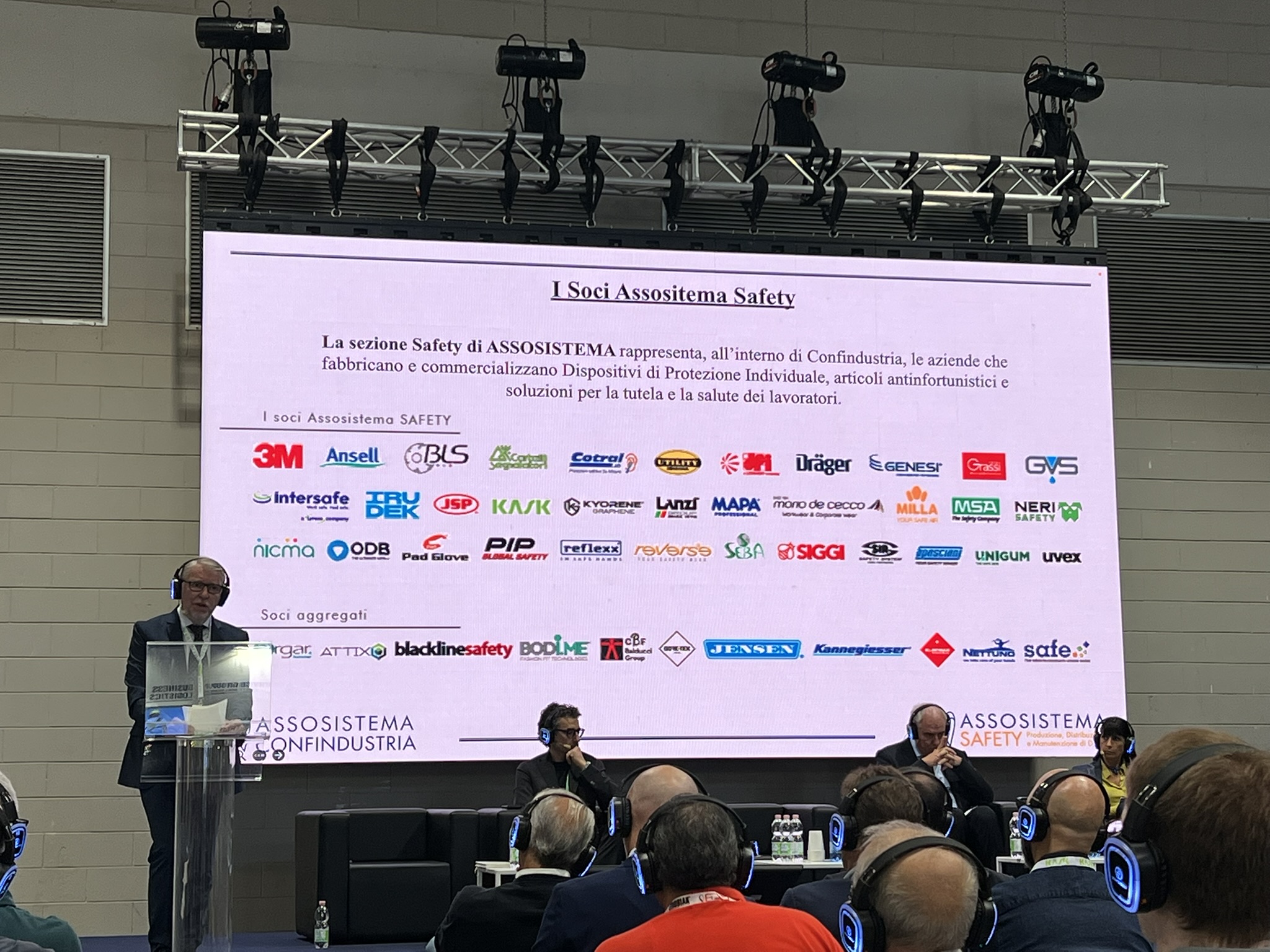
One of the most relevant sessions for Bodi.Me was the Assosistema Safety conference held on 17 September:
“DPI, IoT e AI: le nuove tecnologie a supporto della sicurezza sul lavoro. Opportunità e sfide per le aziende e gli utilizzatori.”
The conference brought together representatives from institutions, industry, academia and manufacturing to examine how smart PPE, artificial intelligence and connected technologies can support workplace safety.
The programme included:
- Claudio Galbiati, President of Assosistema Safety
- Senator Guido Castelli
- Avv. Lorenzo Fantini, moderator
- Cinzia Frascheri, labour lawyer and member of the UNI PPE-IoT working group
- Fabrizio Benedetti, INAIL
- Fabio Pontrandolfi, Confindustria
- Emanuel Bonanni, Confezioni Mario De Cecco
- Venanzio Arquilla, Politecnico di Milano
The official programme confirms the session focused on the opportunities and challenges created by new technologies for both businesses and users.
A question from the public: how important is correct fit for safety?
During the discussion, Avv. Lorenzo Fantini read a question submitted by the audience:
“In the debate around new technologies for workplace safety, there is a great deal of discussion about PPE, IoT and AI. But how important is the correct fit of a garment to the effective protection of the worker? And how can digital size-and-fit technologies help companies collect real data, assign the most appropriate size, and reduce the risks associated with incorrectly fitted or worn PPE and workwear?”
Dott. Claudio Galbiati then invited Lara Mazzoni, CEO of Bodi.Me, to respond on behalf of Bodi.Me, a specialist fashion fit technology company working on size optimisation across garment production, stock management and final distribution.
The question goes to the centre of an issue that can sometimes be overlooked in conversations about workplace technology.
Before a garment becomes connected, intelligent or AI-enabled, it still has to fit the person wearing it.
Why does correct PPE and workwear fit matter?
Correct fit is not only about appearance.
For workwear and protective clothing, fit can affect movement, comfort and how effectively the garment performs its intended function.
A garment that is too tight can restrict movement. One that is too loose may interfere with equipment, create unnecessary bulk or make it more difficult for the wearer to move naturally.
Bodi.Me’s existing work on uniform fit also highlights that garment fit influences comfort, confidence and functionality. In more demanding working environments, those factors can become particularly important.
There is another challenge: people do not all have the same body proportions.
Age, height, body shape, sex, gender, disability and changes throughout a person’s working life can all influence garment fit.
The traditional approach of assigning one standard size to an individual and assuming that size will work across every garment does not reflect the complexity of real bodies or garment construction.
A worker may require one size in a jacket, another in trousers and another in a protective outer layer because each item has a different pattern, fabric behaviour and intended fit.
How can digital size and fit technology improve worker safety?
Digital sizing can help organisations make more informed decisions before the garment reaches the wearer.
Rather than relying only on self-selected sizes, historical assumptions or generic size charts, size-and-fit technology can combine wearer information with garment-specific data to identify a more appropriate size.
For Bodi.Me, this is where AI and machine learning can make a practical contribution to workplace clothing and PPE programmes.
- AI and machine learning can help deliver a better fit
Bodi.Me’s Size-Me platform uses algorithms, machine learning and garment-specific rules to compare wearer information with garment specifications and provide a personalised size and fit recommendation.
The system can consider information including:
- wearer inputs
- estimated or supplied body measurements
- garment measurements
- garment grading
- fit tolerances
- preferred fit
This allows the recommendation to be garment-specific rather than simply assigning one generic size to the individual.
The objective is simple:
help each person receive the most appropriate available size for each garment.
- Better digital sizing can improve safety and speed
Large uniform and workwear programmes often involve hundreds or thousands of employees across multiple locations.
Traditional sizing can involve manual measurement sessions, physical fitting events, sample garments, spreadsheets and repeated exchanges.
Digital sizing can simplify this process.
Size-Me can be accessed through an existing ordering system, secure URL or QR code. The standard wearer journey does not require photographs, body scans, specialist hardware or an app download.
This can help organisations:
- collect size information remotely
- reduce dependence on physical fitting events
- provide recommendations more quickly
- improve consistency across large workforces
- reduce avoidable sizing mistakes
- support multi-site and international programmes
For the employee, the journey should remain simple.
For the employer or supplier, the process can generate more structured sizing information.
- Better fit data can reduce costs across the supply chain
Digital fit technology can also create value beyond the individual recommendation.
Aggregated and anonymised size-demand information can help organisations understand what sizes are actually required before garments are manufactured, ordered or distributed.
This can support three important areas.
Production optimisation
Manufacturers can use real wearer demand to build more accurate size curves and decide how many garments to produce in each size.
This reduces dependence on generic historical ratios and assumptions.
Stock optimisation
Uniform suppliers and employers can compare expected size demand with available inventory.
This can help identify:
- excess quantities of low-demand sizes
- potential shortages
- unnecessary stock
- replenishment requirements
Distribution optimisation
Size information can also help organisations allocate stock more effectively across sites, regions or distribution centres.
The aim is to deliver:
the right garment, in the right size, in the right quantity, to the right location.
Bodi.Me’s existing Size-Me approach already uses aggregated size-demand information to support production, purchasing, stock and distribution decisions.
Better fit therefore has the potential to support both worker experience and operational efficiency.
Smart PPE should solve a real problem
Another important message from the Assosistema panel was that technology should not be introduced simply because it is available.
Our notes from the discussion highlighted smart sensors, intelligent clothing, training and the importance of avoiding unnecessary technological complexity.
For organisations considering smart PPE, a useful question is:
What specific problem does this technology solve?
Connected PPE can potentially monitor environmental conditions, detect incorrect use, generate alerts or help identify unsafe situations.
But implementation must remain understandable for the worker.
If technology creates unnecessary complexity, requires excessive training or produces information that no one can act upon, its practical value becomes questionable.
The technology should support the safety process — not become another obstacle within it.
Safety technology must also respect worker privacy
Connected PPE introduces another significant issue: data.
The Assosistema discussion also considered the difference between collecting information for prevention and creating systems that monitor individual workers.
Our notes from Cinzia Frascheri’s contribution highlighted concerns around physiological data, monitoring and the importance of balancing safety objectives with workers’ rights.
This creates several important questions for organisations adopting connected safety technology:
- What information is genuinely necessary?
- Why is it being collected?
- Who will have access to it?
- How long will it be retained?
- What decision will be made from that information?
- Does the worker understand how the system operates?
Safety technology should use the minimum information required to achieve its purpose.
This is also relevant to digital sizing.
Bodi.Me’s standard Size-Me journey has been designed around data minimisation, with different programme configurations requiring only the information needed to generate the relevant recommendation.
Inclusive PPE must recognise different bodies
The future of PPE cannot be based on the assumption of one standard worker.
A modern workforce includes people of different ages, heights, body shapes and physical requirements.
The Assosistema discussion specifically raised the importance of considering gender, height, ageing and different wearer needs when designing and selecting protective clothing.
This is particularly relevant as organisations focus more closely on inclusive PPE and workwear.
A more inclusive approach begins with better information about the people who will actually wear the garments.
Digital size and fit technology can help manufacturers and employers understand workforce requirements earlier, creating opportunities to improve:
- garment size ranges
- pattern development
- grading
- stock planning
- allocation
- wearer choice
That data can also help identify where existing garment ranges do not adequately serve particular body profiles.
Controlled testing before large-scale implementation
Another strong theme from Safety Expo was experimentation and testing.
New safety technologies should not move directly from concept to large-scale deployment without understanding how they perform in realistic environments.
Testing should consider more than technical functionality.
Companies should ask:
- Does the technology solve the intended problem?
- Can workers understand it?
- Is it comfortable?
- Is it easy to use?
- Does it interfere with other equipment?
- Does it collect only necessary data?
- Can the organisation support it operationally?
- Does the commercial benefit justify the implementation?
Our notes from the conference specifically refer to the value of controlled experimentation when assessing new technologies.
This approach is equally relevant to digital sizing.
Pilot programmes allow organisations to compare recommendations against real wearer feedback, garment try-ons and actual size demand before scaling the technology across a larger workforce.
AI should support human knowledge — not replace it
One of the broader lessons from Safety Expo 2026 was that artificial intelligence does not remove the need for professional judgement.
AI can analyse data quickly, identify patterns and support decisions.
But workplace safety still depends on human knowledge, proper training, appropriate product selection and clear responsibilities.
The same applies to digital sizing.
Size-Me provides an advisory garment-specific size recommendation. It does not replace PPE certification, specialist fit testing, manufacturer instructions or an employer’s safety responsibilities.
Digital technology should strengthen the decision-making process rather than replace the professionals responsible for worker protection.
From smarter PPE to smarter supply chains
Safety Expo 2026 demonstrated how quickly the workplace-safety ecosystem is evolving.
AI, sensors, IoT and connected PPE can potentially help organisations identify risks sooner and respond more effectively.
Digital size and fit technology adds another layer to that ecosystem.
By connecting real wearer requirements with garment-specific information, organisations can potentially improve:
- garment fit
- wearer experience
- sizing accuracy
- production planning
- inventory management
- distribution
- sustainability
For Bodi.Me, the opportunity is therefore broader than simply helping someone select a size.
It is about connecting the individual wearer with better decisions throughout the garment supply chain.
The future of safety technology must remain human-centred
The most advanced technology is only valuable if it works effectively for the person who has to use it.
That means workplace innovation must continue to consider:
Safety.
Fit.
Comfort.
Usability.
Privacy.
Inclusivity.
Cost.
Simplicity.
As Claudio Galbiati observed at the end of Safety Expo 2026, the tools are increasingly available.
The next challenge is choosing the technologies that genuinely improve worker protection — and making sure they can be adopted effectively.
For Bodi.Me, that begins with a fundamental principle:
Before making a garment smarter, make sure it fits the person wearing it.
Frequently Asked Questions
Why is correct fit important for PPE and workwear?
Correct fit can support comfort, movement and the intended functionality of a garment. Clothing that is excessively tight may restrict movement, while garments that are too loose can create unnecessary bulk or interfere with equipment. The appropriate fit depends on the garment, task and protective requirements.
How can AI help with PPE and workwear sizing?
AI-powered sizing systems can analyse wearer information together with garment measurements, grading and fit parameters to recommend an appropriate available garment size.
What is digital PPE sizing?
Digital PPE sizing uses wearer information and garment-specific data to support size selection before protective garments or workwear are issued. It can reduce reliance on manual sizing and generic size charts.
Can digital sizing replace PPE fit testing?
No. Digital sizing can support garment-size selection, but it does not replace certification, specialist fit testing, risk assessment, manufacturer requirements or employer safety responsibilities.
How can size data reduce workwear costs?
Aggregated size-demand data can help manufacturers, suppliers and employers improve production quantities, purchasing, stock levels and distribution. Better forecasting can reduce excess inventory, shortages, exchanges and emergency deliveries.
How does Bodi.Me Size-Me work?
Size-Me uses algorithms, machine learning, wearer inputs and garment-specific information to generate personalised size and fit recommendations. Its standard journey does not require photographs, body scans or specialist hardware.