
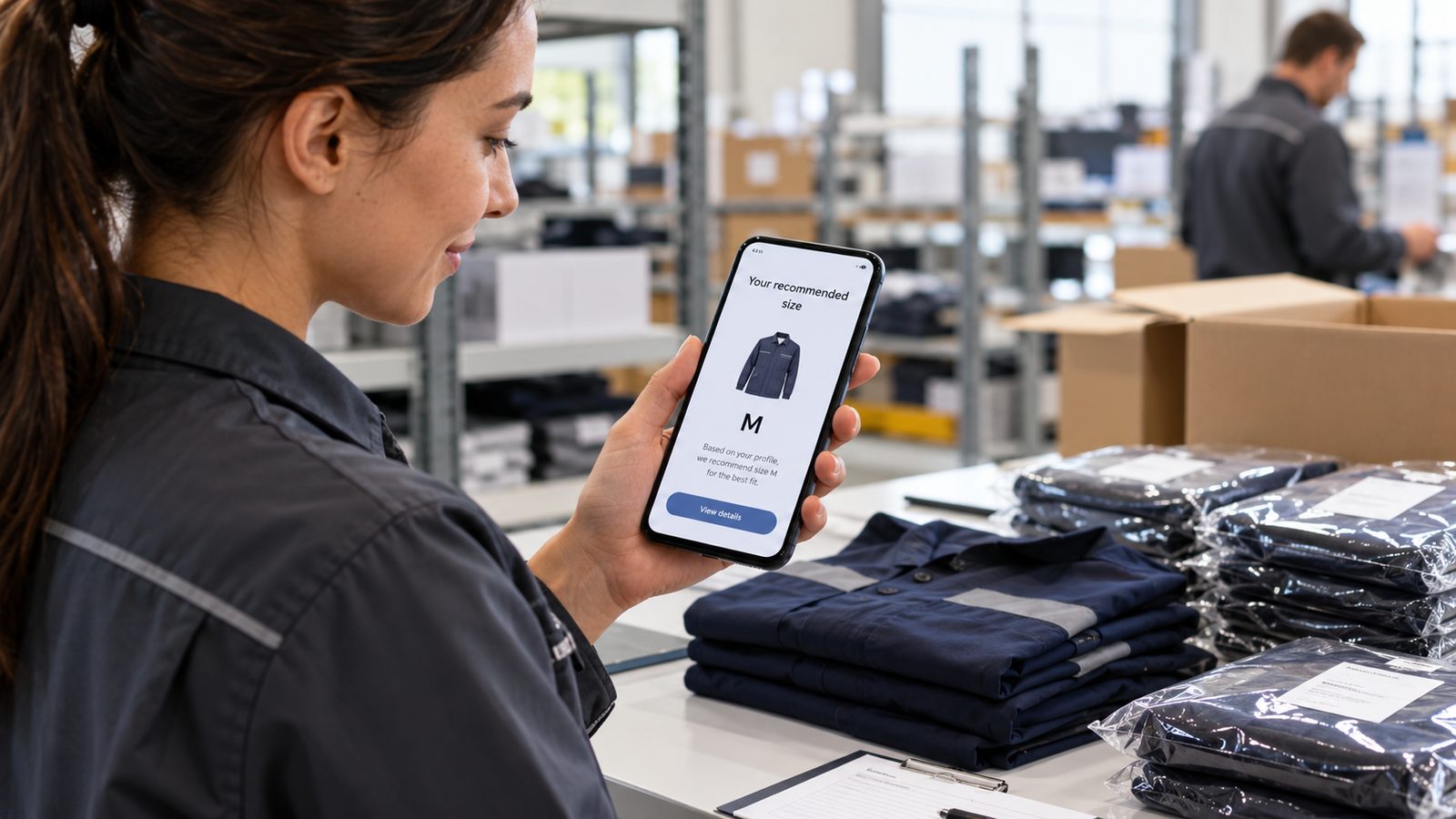
Uniform manufacturers and suppliers face a familiar challenge: supplying every employee with the right garment size, at the right location, on the first attempt. Incorrect sizes lead to exchanges, administrative work, surplus inventory and avoidable costs. Digital sizing and fit technology offers a way to address these issues across the uniform supply chain.
Rather than relying solely on physical fittings, paper size charts or employees’ previous clothing sizes, digital sizing software can recommend garment sizes remotely using wearer information and garment-specific data. It can also inform purchasing, production and stock allocation.
What is digital sizing and fit technology?
Digital sizing and fit technology is software or measurement technology that helps identify the most appropriate garment size for an individual. Solutions vary: some use 3D scanning or smartphone photography, while others combine wearer responses with garment measurements, fit preferences and predictive models. The practical objective is the same: improve size selection before garments are ordered or distributed.
Bodi.Me’s Size-Me 5.1 is a browser-based, AI-powered sizing platform designed for uniforms, workwear and professional clothing. Wearers answer a small number of questions on their own device and receive garment-specific size recommendations. No photographs, body scan or app download are required for the standard remote-sizing experience.
1. “We already have our own sizes and grading”
Having an established size range does not guarantee that every wearer knows which size to choose. Employees may need different sizes across garments, and labels such as M, L or 42 do not necessarily translate consistently between suppliers, styles and fit profiles.
Digital sizing technology complements existing size charts and grading. By matching individual wearer information against specific garment data, it helps allocate the sizes already being manufactured more accurately. For manufacturers, the benefit is not necessarily changing the collection; it is improving the quality of the demand data used to produce and distribute it.
2. “Our uniform return rate is already low”
Even a modest rate of size-related exchanges can become expensive in a large uniform programme. Costs extend beyond replacement garments to include shipping, handling, customer service, reallocation, alterations and delays. Branded or role-specific garments may also be difficult to redeploy.
Improving first-time fit can help reduce these avoidable processes. Bodi.Me has reported substantial reductions in returns in selected deployments, although outcomes vary with garment calibration, wearer participation and programme design. Every uniform provider should measure its own baseline and post-launch results rather than assuming one universal savings percentage.
3. “Our customer handles measuring and returns”
Transferring responsibility for fittings to the employer does not remove the cost from the overall programme. In-person measuring sessions require scheduling, sample garments, staff time and coordination across sites. These burdens are especially visible in hospitality, healthcare, aviation and other distributed workforces.
Remote digital sizing enables employees to complete the sizing process from their own smartphone or computer. It can reduce dependence on physical fitting events and speed up collection of size-demand information before procurement. The supplier benefits when customers can deploy uniforms efficiently and with fewer follow-up exchanges.
4. “We do not want employees to take body photographs”
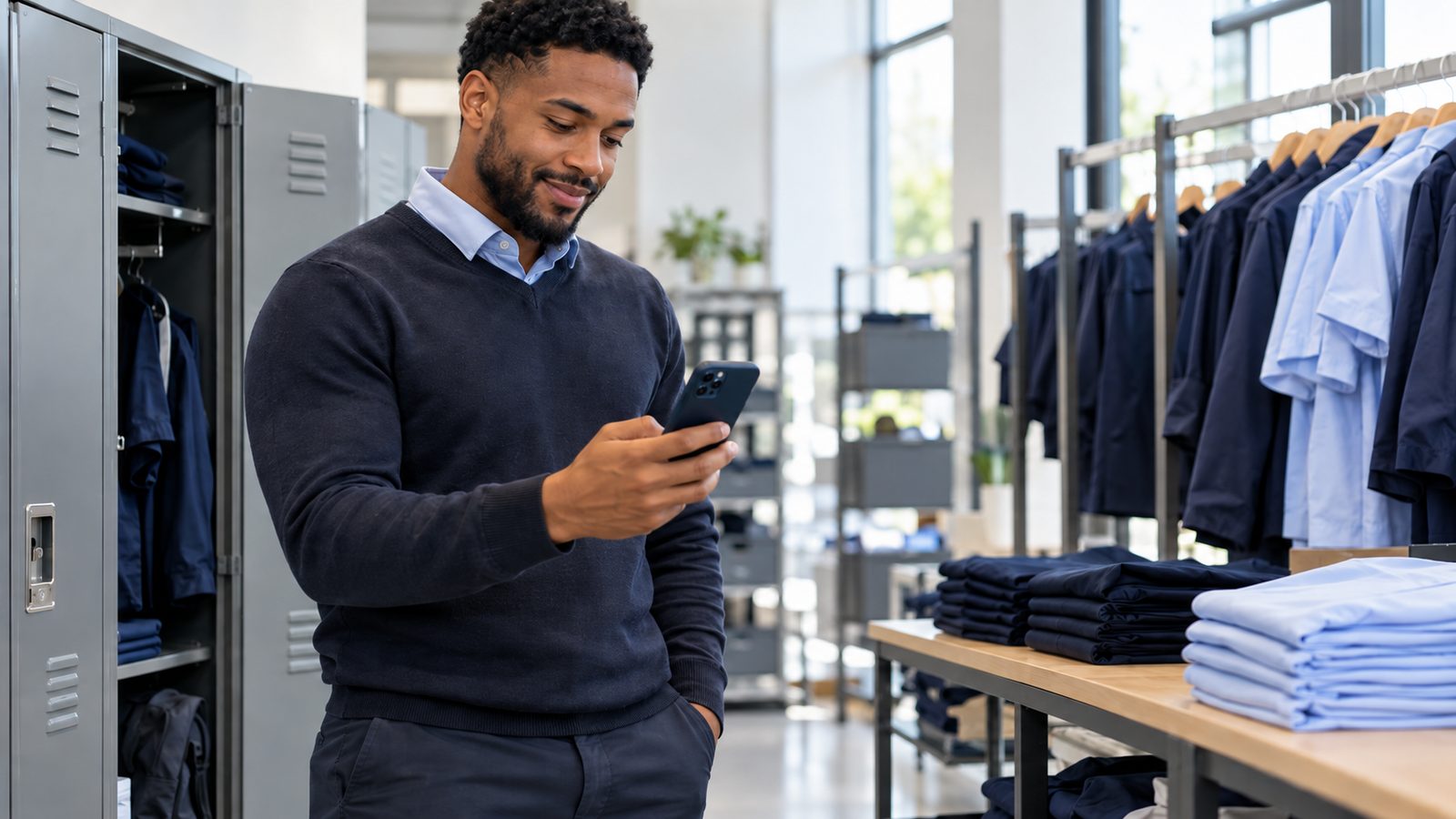
Employee privacy, dignity and accessibility should be considered when choosing a sizing solution. Some tools require a photograph, a scan or specialist equipment; others use a questionnaire-based approach. Employers should assess what data is collected, why it is needed, how it is secured and whether the process can be used conveniently by a diverse workforce.
Size-Me 5.1 uses non-intrusive wearer inputs to generate remote size recommendations without asking users to submit photographs or download an app. It can be accessed through a URL, QR code or an integrated ordering platform. As with all fit systems, recommendation quality depends on the information provided and the accuracy of garment calibration.
5. “We already use sustainable fabrics”
Recycled or lower-impact materials are important, but sustainability also depends on how many garments are manufactured, transported, exchanged and ultimately left unused. A uniform programme can still generate waste if its size mix does not match the people who will wear the garments.
Better sizing information can support more accurate forecasting and purchasing by size, role and location. The resulting opportunity extends from fit recommendations into supply-chain optimisation: ordering quantities closer to actual demand, distributing available stock more effectively and reducing unnecessary replacements and overproduction.
From size recommendations to supply-chain optimisation
The strongest business case for digital sizing goes beyond the fitting step. When individual recommendations are combined into privacy-conscious, aggregated size-demand information, organisations can make better operational decisions across the uniform lifecycle:
- Procurement: estimate demand by garment and size before placing orders.
- Manufacturing: align production runs more closely with actual size requirements.
- Stock allocation: distribute the right size mix to the right sites and teams.
- Fulfilment: reduce avoidable exchanges, replacement shipments and delays.
- Sustainability: limit surplus garments and unnecessary logistics where improved accuracy translates into operational change.
Frequently asked questions
What is uniform sizing software?
Uniform sizing software uses wearer information and garment data to recommend suitable sizes for uniforms, workwear or PPE-related garments. Systems differ in the inputs and measurement technology they require.
Can digital sizing work without a body scanner?
Yes. Some digital sizing platforms provide remote recommendations using a short questionnaire and garment-specific data, without requiring photographs or a 3D scan.
How does AI sizing reduce uniform returns?
It can help employees select a more appropriate garment size before ordering, reducing avoidable size-related exchanges. The actual reduction depends on data quality, garment fit consistency and implementation.
Can sizing data help optimise uniform stock?
Yes. Aggregated size-demand patterns can help organisations forecast quantities, plan purchasing and position stock by garment, role and location.
Is digital sizing useful for small and large uniform programmes?
It can be useful in both, although the financial case is often strongest where there are many wearers, garments, locations or repeated replacement cycles.
Choose the right size. Plan the right quantity.
Digital sizing technology gives uniform providers a practical opportunity to improve wearer experience while making procurement, stock management and distribution more efficient. A well-implemented system helps organisations move from reactive exchanges to more accurate, data-informed uniform planning.
Bodi.Me’s Size-Me 5.1 connects personalised garment size recommendations with intelligence that can support broader uniform supply-chain decisions.
Right size. Right quantity. Right location. First time.
Discover Size-Me at https://bodi.me/
About Bodi.Me
Founded in 2013, Bodi.Me is a UK-based developer of digital sizing and fit technology for uniforms, workwear and professional clothing. Its Size-Me platform helps organisations provide personalised garment size recommendations and improve decisions across procurement, stock allocation and distribution. Bodi.Me has delivered more than 1.5 million personalised size recommendations across its programmes.
Sell More. Waste Less.